If you’re releasing on Vinyl and Digital OR Digital-Only, we’ve got you covered. Get the ultimate record release gravitas on all formats with MORE than just mastering, at an incredible price! For the best professional-sounding results, masters need to be finished differently for Vinyl, Streaming and Download+CD, as these formats all have different technical requirements…
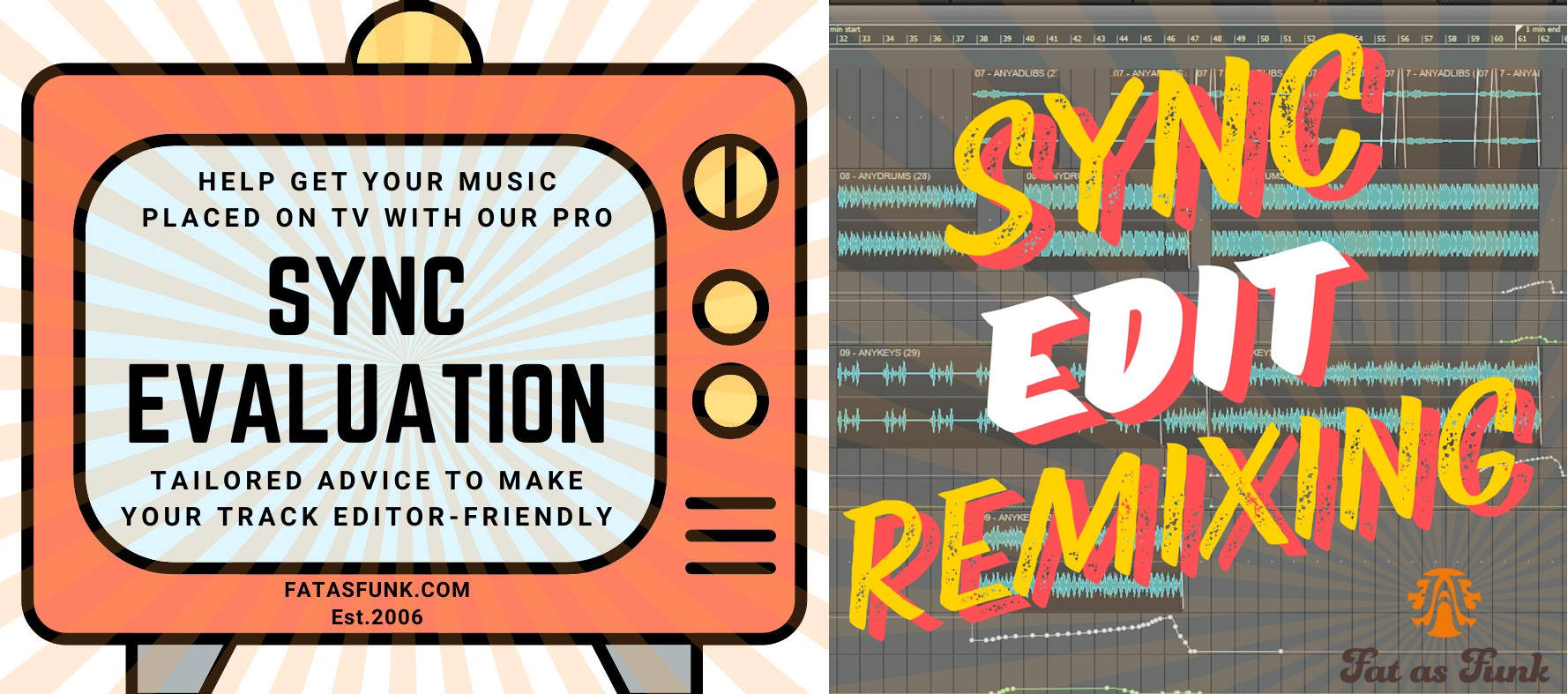
Boost the potential for your tracks to be used on TV, films and more with our new Sync Services. Sync Evaluations & Sync-focused Remixes maximise your chances of landing that elusive sync deal and making some serious money…
We all love a classic Analogue Synthesizer. The warmth, the rich tones, even the circuit noise all add a certain loveliness that a software synth cannot match. The question of soft synth vs hard synth has a clear winner – one that weighs several kilos and comes in a box! Reissued synths are a way…
They say time flies when you’re having fun. Never truer than when spending the last 17 years working on amazing music. I don’t really talk about myself much at all (ever really), but 17 years is quite a while to be doing a job, so this post is a little bit about my journey so…
Mid-side processing allows you to separate the stereo signal of your mix into two components: the mid and the side. By processing the mid and side components independently, you can shape the stereo image of your mix in radically different ways. In this blog post, we’ll show you what mid-side EQ processing is, how it works, when to use mid side processing, and how you can use it to improve your mixes. We’ll also show you how to use hardware outboard gear to achieve it…
They are a way of measuring the intrinsic volume of a piece of audio, relative to 0dB – which is the absolute loudest signal possible in digital audio – in the same way that a cup can only ever be filled up to 100% full, and no more…
How do artists make money from their music in 2022? Getting your music on TV or in movies, games or advertising is one of the most lucrative ways. Instrumental mixes are essential to land these deals…
How to sound good on a podcast – that’s the goal of many aspiring creators. You create and record valuable content, edit it, and stream it… only to hear that it doesn’t sound as professional compared to some of your peers. There’s so much content available these days, listeners will switch off quickly if your…
There are several different opinions on the question of “What is the best volume to finish my master?” (or for the more technically minded “What LUFS should I master to?”). We can’t avoid mentioning the famous loudness wars in this article either, and the direction music mastering is heading. After many years spent racing towards the loudest master, is the loudness war over?
Having been a professional mastering engineer since 2006, I have a few opinions. I’m going to give my perspective on these questions and explain about LUFS, peak and true-peak (with as little jargon as possible).
The end point is finding the ultimate recipe for the best mixing and mastering finish for your music, and how to win the loudness war in 2021 and beyond…
If you are wondering “How can I make my music sound better?” You may be considering taking your mixes to a pro, but are wondering what service your money is better spent on: professional mixing vs mastering, stem mastering or stereo mastering…
The article is about a professional audio mastering engineer’s use of Zen meditation to achieve a ‘flow’ state, which leads to effective results especially for complex projects. The author stresses the importance of identifying the right middle ground before adjusting dynamics in a record, a process facilitated by their approach of ‘thought without thought’ obtained through Zen. The engineer describes how ‘moving meditations’ and mindfulness enable deeper, non-distracted focus. The author employs Zen, not just technics, to enhance the emotional and artistic connection in a piece…
Releasing a vinyl record is an expensive business. It’s tempting to cut corners where possible to save money, and inevitably the question gets asked… “Vinyl mastering – is a separate master really necessary? Or can I use digital masters for vinyl music?
Short answer = You need a separate vinyl master for the best results.
Often masters created for digital use (Streaming/download/CD) are accepted by the pressing plant, so technically it’s OK to press on vinyl, but the end result is disappointing sound quality.
Using masters optimized for digital use to press vinyl will usually result in a slightly flatter sound, less dynamic range, various levels of distortion, skipping needles when playing back, and less overall “life” on vinyl – a crying shame after spending so much money on getting the records pressed!
“Can mastering save a bad mix?” is a common question. The short answer? = Yes…. to an extent. It’s always better to fix your mix at the mix stage, rather than waiting to fix the mix in mastering, but what if you don’t have the project file anymore, and still love the track. Do you…
How to make it in the music industry? Whatever musical path you choose, you will find lots of new opportunities by attending music industry conferences that happen around the world. We have some tips to help make the most of a trip…
Humans are the natural choice to master your music – A.I. bots are getting better all the time, but they can’t feel the rush of a hot performer, or the anticipation of a bass drop. An A.I. bot will never shed a tear when the violins rise up, or a surge of energy deep within them from a wicked riff. You can… We can…
One of the most common questions we are asked is “how do I prepare a song for mastering”. It’s an important stage to get right, as the quality of audio going into the mastering chain makes a big difference to the final result of the master. When you’re looking for the best song mastering services…
Now there are more opportunities than ever to become a professional DJ – and it’s a more crowded market than ever before because of it! So how do you get your mix to stand out to listeners, booking agents and promoters on common platforms like Mixcloud, Soundcloud, Spotify etc? Mastering is an overlooked step that makes you stand out as a pro DJ…
Time flies. Fat as Funk is 12 years old in a couple of weeks. A lot has happened. We were one of the very first to offer free mastering tasters back in 2006, and since then have had the pleasure of working on over 10,000+ tracks! We’ve seen the rise of some of our regulars…
If you’re releasing on Vinyl and Digital OR Digital-Only, we’ve got you covered.
Get the ultimate record release gravitas on all formats with MORE than just mastering, at an incredible price!
For the best professional-sounding results, masters need to be finished differently for Vinyl, Streaming and Download+CD, as these formats all have different technical requirements.
Using the same masters for every format leads to compromises between streaming or download, and worse – problems with a vinyl cut (even getting rejected by the plant!).
These extra mastering costs can mount up, so we have created these great-value packages saving 25% so you don’t have to compromise on your release.
Choose the package that fits your groove: Vinyl & Digital or Digital-Only, and get perfect sound across every format.
“In my 25 years within the Music Industry as an A&R man, producer, songwriter, record company owner, lecturer and consultant I’ve had the opportunity of working with some excellent Mastering Engineers. Lawrence I can safely say is one of the best. His understanding of mastering coupled with his easy going approach, flexibility and quality of work at a decent price make him an absolute treasure to work with in his particular field. I can’t recommend him enough.” – Richard Rogers – Ex Head of A&R for Warner-Chappell
“Loz, it turns out you were the best to my ears, including people in multi-million dollar mastering facilities.” – Augustine Leudar
“When we were preparing our first album, two of the biggest pressing plants recommended Loz to sort out our digital and vinyl masters. We were so impressed with his work that we asked him to mix and master our second album. Communicating our ideas for each song was so easy and enjoyable, and we are delighted with the results. Loz’s calm, zen-like approach, combined with his expertise and knowledge, makes him a pleasure to work with. Highly recommended!” – Olly, Bobsled Team
“I had my band’s tracks mixed and mastered by Loz after trying over 15 studios for mixing and mastering, but no one could get the sound I was looking for on my songs like Loz! The end result was amazing and the sound came out exactly how I wanted it. The attention to detail was great and I’m really happy. I highly recommend this studio to anyone looking for top quality mixing and mastering.” – Bill Sam, Nightsteel
Since 2006, we’ve been making records rise above the noise, full-time.
Your dream release? It starts here.
Pick Your Package:
1: Vinyl AND Digital release
Lush analogue masters. Individually optimized for the best vinyl cut, streaming, CD, cassette, and download – ultimate sonic gravitas for your release.
Plus get everything sounding amazing before the final mastering stage including:
Mix Evaluations: Refine your mixes at home with detailed advice before we master them
OR Mixing + Mastering: We handle everything for pro-level polish and an easy life for you!
2: Digital-only release
Lush analogue masters crafted for streaming, download, CD (and cassette too!) – zero compromise.
Plus get everything sounding amazing before the final mastering stage including:
Mix Evaluations: Tweak your mixes at home with detailed advice before we master them
OR Mixing + Mastering: Full-service sound from the ground-up for best results, and an easy life for you!
Does that sound like the record you’ve been dreaming of?Achieve it AND save 25%
Fat As Funk has been the “in house” mastering engineer for 3 of the biggest UK pressing plants for many years and have shaped the sound of vinyl releases for thousands of artists, from household names to independents.
“We’ve been working with Fat As Funk for over 10 years and Loz is my go-to guy for pre-vinyl mastering. His expertise is always on point, and he knows how to get any masters sounding great on vinyl. It’s always a smooth ride with clear communication and quick turnaround.” – Graham Worsfold, Key Production (a top pressing plant)
“We have used Loz and Fat As Funk mastering as our ‘In House’ mastering engineer for some years now and we have absolutely no intention of changing that any time soon. Loz’s versatility and attention to detail when mastering across all genres and for all physical media and digital media outputs is second to none in the business. Fat As Funk is a genuine 5 star service.” – Adam M – Director: Cram Duplication & Vinyl (a top pressing plant)
“We have been using Loz/Fat as Funk Mastering through Breed Media for years and always receive a friendly, timely and quality service/results from him for vinyl mastering, as well as level checking and DDP conversions for CD work. We have trusted him with projects ranging from household name artists to customers putting out their first release and would gladly recommend his services whenever we can.” – Ben Ward, Breed Media (a top pressing plant)
“Always a pleasure to work with Loz. Turns jobs around quickly for me when time is of the essence! And what he does is always amazing – Top job!”– Liz Brown, Key Production (a top pressing plant)
The Package Details
1: Vinyl + Digital Release:
Option 1A: Analogue mastering for vinyl + digital release, with pre-mastering mix optimisation advice
Detailed Mix Evaluation on every track to refine your mix at home pre-mastering. Better mix in = better master out!
High-res masters optimised for digital use (& Cassette too!)
Pre-vinyl optimised masters for an unmatched quality vinyl cut
Streaming-optimized masters to stand out in the crowd
16 bit / 44.1 masters for CD(and some digital distributors)
Best-quality MP3s made from our 32 bit highest-quality files with metadata text included
£68 per track (usually £91), 4 tracks minimum. Save ~25%
Option 1B: Analogue mixing + mastering for vinyl & digital Release
Pro mixing and mastering of up to 10 instrument stems per song(more stems are OK with a surcharge of £7 per stem)
High-res wav masters optimised for digital use (& Cassette too!)
Pre-vinyl optimised masters for an unmatched quality vinyl cut
Streaming-optimized masters to stand out in the crowd
16 bit / 44.1 masters for CD (and some digital distributors)
Best-quality MP3s made from our 32 bit highest-quality files with metadata text included
£136 per track (usually £181). 4 tracks minimum.Save ~25%
£212.00–£1,936.00Price range: £212.00 through £1,936.00
Due to the extra workload, we can only do a few of these packages per month. Book now to secure your deluxe release package.
The Release You Always Hoped For, Delivered
“Loz! WOW. They sound beautiful. Kind of crying. Been 2.5 years to get here. Can’t believe it. That you got such round bottom-end with such depth to the mix as well, no loudness madness, is really impressive and everything I’d hoped for.” – Jung Jungle
“Fat As Funk has changed average recorded music into tracks suitable for national exposure on radio stations for me.” – Rob Saunders, Deuce Management
Nothing Quite Like Vinyl
Vinyl isn’t just a format—it’s a legacy. Your tracks deserve that warm, rich depth. Plus digital masters that cut through on Spotify and beyond. I’ve got the gear, the experience, and the pressing plant connections to make it happen effortlessly. There’s nothing like the feeling of unwrapping your first vinyl record! This is your shot to create something that stands the test of time and sounds as good as the best. Something to be truly proud of.
(From a client with his own vinyl cutting lathe) “I did a test cut of your demo master alongside a demo master from another mastering engineer and I can confirm your master was really good, translated to vinyl well and was far better than the other engineer. I liked the way that you didn’t slam the mix too hard and the integrity of my mixdown was still there but you just made it come alive more and made it sound nice & punchy and also louder without destroying the dynamics.” – Ben, I & I Musik
Getting Physical?
CD and Cassette releases are gaining popularity again, and our masters for digital use will sound perfect on these formats too. We can also give you a master Cassette for you to duplicate from for an additional fee.
“We’re delighted with those masters you sent us. They really are perfect and everyone on our end is happy.” – A Futurist Theatre
Your dream sound, elite and affordable
“These masters are phenomenal ! I still can’t get over how you can take a stereo stem and make it groove and move more with mastering… You’ve brought out details that I haven’t heard before and I’ve been obsessing over these mixes for two years. The vox sound front and centre without compromising the music. We love them and we’re delighted with the overall service – brilliant communication and a speedy turnaround without impacting the quality. All magic. We haven’t even considered trusting our music to another mastering engineer – that won’t change ! Thank you again.” – Strange Crazy
Boost Your Sync Licensing Potential with Our Expert Services
TL;DR
“Sync licensing” = Lucrative opportunity to get your music in TV, films, games, ads, and more
High earning potential: £300 to £30,000+ per placement, even for unknown artists
Our new services help maximize your chances of landing sync deals
1. Sync Evaluation Service
Professional mix notes plus sync-specific advice for your song
Identify and avoid red flags in your tracks
Optimize arrangement and sound selection for sync use
2. Sync Editing Remix Service
Three options to suit your needs: a) Custom remix using stems: Tailored for sync, with strategic edits and arrangement b) Basic remix from stereo file: Effective edits to enhance sync potential c) Movie Trailer Remix: Completely transform your track to suit high-end trailers and promos, one of the most lucrative parts of the industry
Our services provided by an industry veteran with 10+ years of successful sync experience
Proven track record: Placements in major films, TV shows, and trailers
Don’t miss out on sync opportunities – let our expertise guide your music to success! Read more below.
What is Sync Licensing? Getting your music used on TV, films, video games, adverts, movie trailers and sonic branding – and getting paid for it! Sounds great, but is sync licensing worth it? Yes! It is one of the few remaining ways to earn good money from your music, and best of all you don’t need to have a huge social media following, chart hits, or millions of streams.
How much does sync licensing pay? A wide range of fees. Decent syncs pay anywhere from £300 to £30,000+ for a relatively unknown artist depending on many factors – show budget, duration of use for the song, if it’s a background or feature use, title sequence or end credits use, length of time a campaign will be running, types of media it will be played on, territories…. so there is no magic number and every sync is different. Obviously £30,000+ is much rarer, but it can happen even for unknown artists with the right connections (we can also help with these connections, & have helped land numerous sync deals for our clients over the years). Often 1 sync license will pay as much as millions of Spotify streams, usually with ongoing back-end performance royalties too. This is why sync licensing is seen as the holy grail for musicians. All genres are used for sync licensing projects.
Sync Licensing 101 includes having a professional sounding mix and master. We’ve been helping with that for 18 years now. But there’s a lot more you can do to maximise the chances your song will be picked for a sync by a music supervisor – the person who chooses songs for the film, TV or advertising project).
What are sync licensing companies looking for? Other sync licensing requirements include good metadata organisation, no unlicensed samples, having accurate writer details, including Performing Rights Organisation (PRO) details for each writer (common PRO include PRS/ASCAP/SACEM etc. and differ for each country).
Probably the most important detail in sync licensing music is how sync-able is the song itself? There are certain considerations to consider for the arrangement and sound selection that music supervisors and editors look for all the time (and will reject a song if it doesn’t meet these specific needs). There are also some common timings that are key to make a song versatile for media. If you get these subtle aspects right, it will greatly improve your chances of landing a sync. It takes a lot of study to really drill down the subtleties of how to fine-tune your song to suit editors and music supervisors.
Breaking in to one of the most competitive areas of one of the most competitive industries can be daunting – how else can you increase your chances to be successful in sync licensing?
Here’s where our new services come in.
Two New Sync Services
Loz, our chief engineer has been active in the sync world for over 10 years. First going to Los Angeles in 2012 to hustle up some business, then making 5 more successful trips, plus regular networking sessions in London. Loz ran a 3rd party sync agency (Rinse The Sync) for a few years landing his artists over 40 placements, and is a composer for legendary LA based trailer music agency Pusher Music. He has been directly involved in placements for Star Wars: Rogue One (trailer), Underworld: Blood Wars (trailer + end credits track), Alien: Covenant (trailer), Antlers (trailer), Star Wars: The Book Of Boba Fett (trailer), and various placements with NBCUniversal, BBC, Canal+, Coca-Cola/Sprite and more. After deciding that running a music library would be more suited to his business goals, he set up Alternative Reality Music library, which is represented by an L.A. based sub-publisher, and has direct deals with 23 countries. He continues to compose for his own and other music libraries and agencies.
Sync Evaluation Service
We have expanded our ever-popular Mix Evaluation Service to include a Sync Evaluation Service.
We will carefully evaluate your track in our mastering suite, and give highly specific mix notes including detailed instrument EQ adjustments and level adjustments (as in our classic Mix Evaluation). On top of this essential info we will give specific advice tailored to your track to make it as sync-able as possible.
Avoid any red-flags in your song, optimise the arrangement, get advice on any sounds that clash with the subtle requirements of sync, and receive suggestions to create alternative versions relevant to your track and goals.
ACTUAL MIX EVALUATION EXAMPLE POINTS TAKEN FROM PREVIOUS JOBS:
“I think the piano is slightly too overpowering. Just drop it down by -2dB & that should balance it nicely with the vocal & strings”
There’s some low-end resonance on the low synth bass/elec piano sound that’s making things a bit muddy. Try an EQ cut of -3dB @ 162Hz, Q of 0.67. This sound could also come down a further -0.5dB afterwards.
“I think the hi-hats coming in at 1 min are a little sharp & overpowering due to the sharp Q on a filter. Reduce the Q level to mellow it out while keeping the intention. Adding a second EQ afterwards in the chain will smooth it & keep the overall filtered effect. Try an EQ cut of -5dB at 8.8kHz, Q of 1 should ease back the volume & tone nicely. The high end can all be brought up together during mastering, which will restore a little brightness to the hats here but keep them balanced with the rest of that section. Only apply this EQ to the filtered hi-hat section 1:00-1:21, as the rest is fine”
“Love the intro. I wonder if the Ebow guitar & the harp conflict ever so slightly around the same frequencies. I suggest you approach this with EQ – Put an EQ cut of around -2.5 or -3 dB @ 500 Hz on the Ebow Guitar, Q of 1, thus letting the harp come through clearer.”
“The fast roll snare sample is a bit muffled. I suspect this is an artistic choice, so that’s cool. But maybe try it a little brighter & it would sound more natural. If it has a little snappy energy restored around the 2kHz mark that should cut through nicely.”
“The short cello solo line (1:18, 1:40 etc.) doesn’t sound integrated fully, kind of sits on top a little muddy. Could it be brighter & quieter? Try a dual EQ approach. Cut of -2.6dB @ 363Hz, Q of 0.7. Then do an EQ boost of +1dB @ 1911Hz, Q of 0.7. This should go a long way to making it sound more natural with the track. Also is it a little dry? What would it sound like with maybe 5% less dry balance on the reverb?”
If you want an expert approach to optimising your tracks for sync use, Loz can remix your tracks into various edits that are precisely tailored to hit the most commonly needed requirements of music supervisors and editors.
We offer 3 flavours of sync remix:
Sync remix using stems (£250) Loz will create a custom remix tailored specifically for sync use, crafting an arrangement that is versatile for editors, including (where appropriate for the genre) artfully placed stop-downs, filtering, fades and edits to craft a narrative arc to your song and deliver different edits that will increase your opportunities to land that elusive sync deal. Uses up to 6 supplied stems. Includes final Mastering.
Sync remix from stereo file (£140) A more basic set of edits, but still highly effective. Includes stop-downs, filtering, arrangement adjustment and building a narrative arc to suit sync use. Bear in mind we’ve been editing audio professionally for 18 years, so we can do a lot with just a stereo file! Includes final Mastering.
Movie Trailer Remix (£1500) A very specialist service that requires a distinct set of skills. Loz has honed these skills for years, and learned directly from the best in the business. He has personally landed his own music in the trailers for Star Wars: The Book Of Boba Fett, Alien: Covenant & Antlers, and crafted trailerized remixes of several Ludakris tracks for season 1 & 2 of the Netflix series Karma’s World, and numerous trailerized remixes of classic original songs for Universal Music. This service is done from stems only, and will open the door for you to the most lucrative market in the sync world. Trailers land the biggest fees due to coming from the marketing budge – not the production budget where music is usually a financial afterthought. Whatever your genre of music we can transform it into an epic production ready for high-end trailers and promos, including final Mastering. The service may seem expensive, but with trailer budgets around $20,000 – $50,000 even for unknown artists, this is a door that is worth opening if you are serious about making a living from music.
Screenshot From A Sync Remix Job
Showing precise arrangement optimisation, filtering, FX, fades, stop-downs etc. in a Sync Remix from Stems. Perfectly tailored for editors. Each remix is crafted bespoke to suit the best sync-fit for your song and goals.
Lanyards from various Sync Conferences and events Loz has attended in LA & London.Loz networking at the centre of the sync industry, Los Angeles Capitol Records, 2015
18 years today I registered my website & sent my first email as Fat As Funk.
I consider this the birth of my company.
I’d like to thank each of you for joining me on this quest for excellent audio.
Some of you have been working with me since right back in 2006. This is incredible, and a testament to how strong relationships can be in a very competitive & fickle industry.
People can stop making music for all sorts of reasons. Labels fold, managers retire, family life gets in the way. But the musical spark lives within.
So many times people come back several years later with a new project. “Remember me?” – of course I do!
Every record I’ve worked on has touched me in some way. I am extremely grateful, & especially that most new clients come to me from heartfelt recommendation (which is great as I’m rubbish at social media!).
18 years is a long time to be doing the same job, & I still love it every day. It’s always refreshing, exciting, fun, rewarding and interesting. I lost count years ago but must be up to about 16,000+ tracks mixed &/or mastered by me. That’s a lot of audio.
I love hearing your new music from literally all around the world.
Right now (6/6/2024) I am working on a returning client’s album from Russia. They asked if I was still working on Russian music – worried I would boycott them due to their government’s war. They don’t want it. They just want to live a good life & make tunes. Music transcends politics & policies. Of course I’ll work on it! It was a major hassle getting the money over, and eventually they had to send it via a friend in Kazakhstan, but we got there in the end. It’s a great album too, a little bit Nirvana / Pixies vibe. I’m on track to deliver it tomorrow.
I’ve made some good friends along the way, and had the pleasure of meeting quite a few of you in person. Seen babies born & grow up, marriages, divorces, deaths, wins & losses all soundtracked by authentic, visceral & interesting music.
It’s a real honour being a part of your musical journey, and I look forward to hearing your next material.
We all love a classic Analogue Synthesizer. The warmth, the rich tones, even the circuit noise all add a certain loveliness that a software synth cannot match. The question of soft synth vs hard synth has a clear winner – one that weighs several kilos and comes in a box!
Reissued synths are a way of getting these amazing authentic sounds and the joy of owning a hardware classic, for a fraction of the price of the original. They are usually modernised with new features and connectivity, and sometimes notable negative points of the original have been improved. For example some early synths were notoriously difficult to tune (and stay in tune!) so by correcting these aspects, it can only be considered an improvement in real terms.
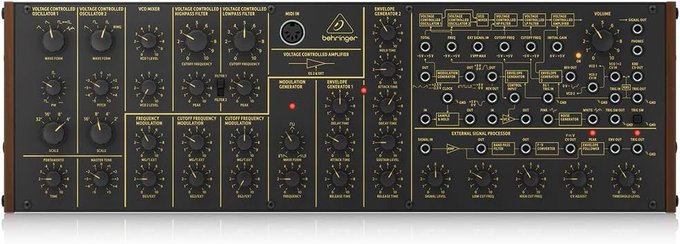
For the heretics (and value-hunters) among us I have also included a few cheaper unofficial Behringer clones of synth classics which are great in their own right, and deliver the goods for even less money. To be fair, Behringer have put a lot of love in to these reissues, boasting all-analogue signal chain, and circuit components that are as close to the originals as possible. I wouldn’t use Behringer products in my mastering chain, but their synths are fantastic, and in the cost of living crisis, it makes total sense to explore going “off-brand” in all facets of life.
If you are wondering “which synth should I buy?” here’s a quick guide to 15.5 (you’ll see why it’s 15 & a half later) of the best classic synth reissues, and a few controller keyboard recommendations at the end. Enjoy!
This article will be updated every so often when I see something else that’s groovy, so please bookmark & check back.
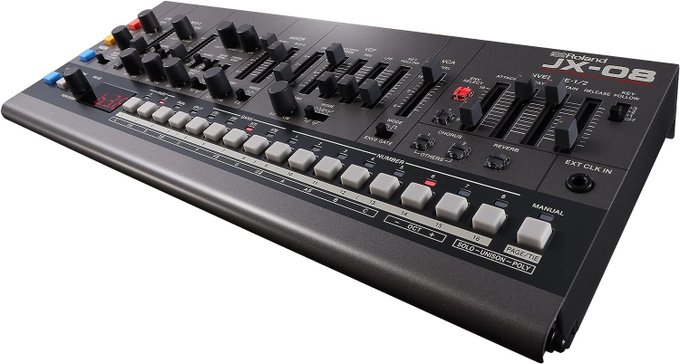
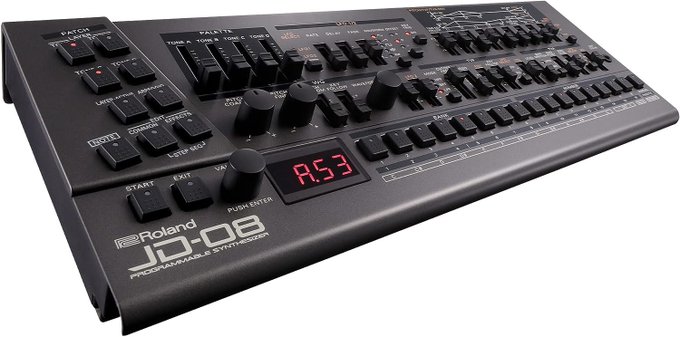
1) Roland JX-8p >>> JX-08
Modern Reissue of the Legendary Roland JX-8P from 1985 with New Effects, Polyphonic Sequencer, and More. I had a hardware JX3-p, its predecessor for around 20 years and it was incredible. The JX8-p is considered an upgrade, and this reissue is a beauty!
The Roland TB-303 (1981) is one of the most legendary in the world of electronic music. The reissue (TB-03) is a compact, affordable, and modernized version that retains the original’s unique sound. Aciiiid!
Behringer also make a clone of the 303 for an insanely low price, the TD-3-BK at Just over £100. Bear in mind an original 303 will set you back several thousand (IF you can find one), and just the manual alone sells for several hundred, this Behringer clone is an incredible deal.
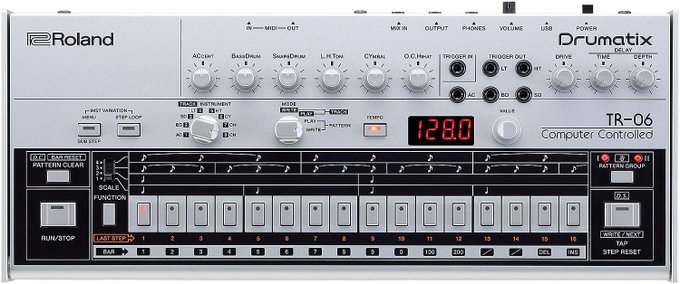
The TR-606 (1981) was designed to be paired with the 303, so a lone singer could have their own bassline and drums without having to organise a band. Then a swarm of electronic artists had different ideas, and music has never been the same again… The TR-06 reissue captures the chunky vibe of the original and adds a wealth Modern Upgrades
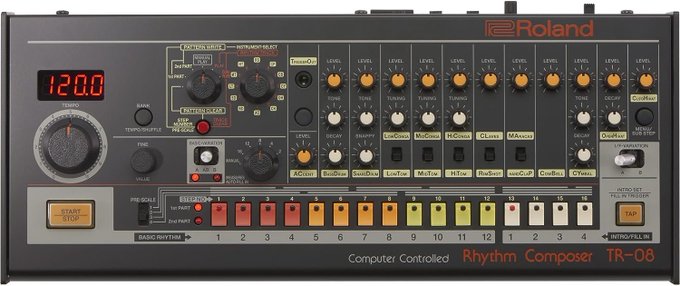
The Roland TR-808 (1980) is the most famous drum machine ever made. The backbone of House music and Hip-Hop, with heavy use across most other electronic genres too, it remains an essential (and incredibly expensive) bit of kit. The reissued TR-08 is a compact, affordable, and modernized version that retains the original’s unique sound.
The RD-8 Behringer clone also has an all analogue signal path, and is almost half-price again. They are shameless, yes, but also offer a great opportunity to producers who want the real analogue feel without spending too much dosh. 11 individual analogue outputs allows you to record or process your drums in multitrack.
The Nepheton by D16 is a high-end 808 VST with extra features.
5) Roland TR-909 >>> RD-9
Similar to the 808, but with harder sounds, the 909 grew to become the backbone for Techno and Industrial music, but features in almost all electronic genres too. This all-analogue clone is fat and chunky, with 10 individual outputs and reasonably priced.
TheDrumazon 2 by D16 909 simulator completes the holy trinity of classic drum machine VST instruments.
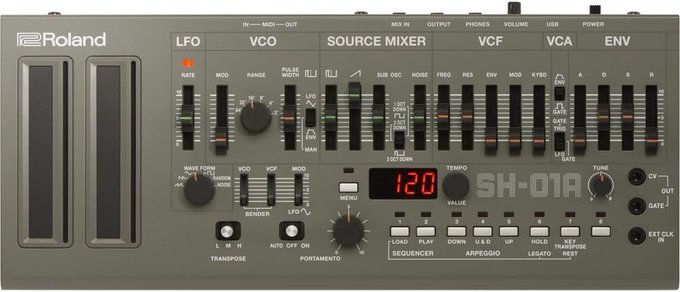
6) Roland SH-101 >>> SH-01A
The Roland SH-101 (1982) is a classic 80s monosynth which is capable of some truly savage tones. There’s just something about it which screams! The reissue (SH-01A) is compact, affordable, and has some new features.
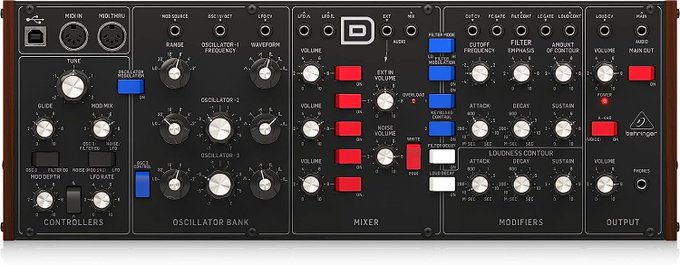
The Moog Minimoog (1970) is one of the most famous synths ever made, and for good reason. A true icon, the originals are incredibly expensive and rare, and mere mortals like us are unlikely to ever even touch one. The cloned Behringer Model D is pretty darn-tootin’ at a fraction of the price of an original.
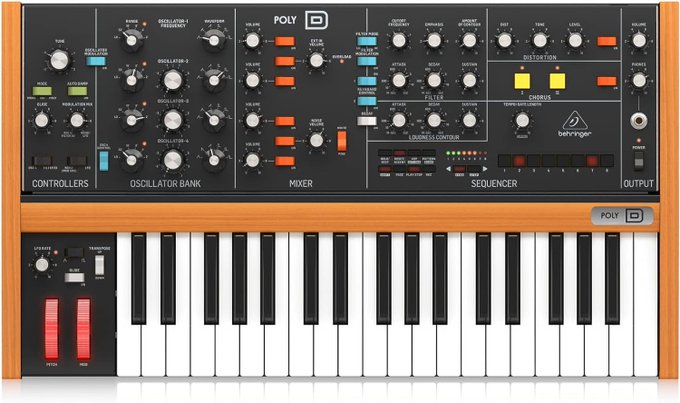
Here’s why the article is call 15 & a half synth reissues… there is also a polyphonic version of the Minimoog Model D which is also made by Behringer: The Poly D. It’s actually technically paraphonic, which can lead to new and interesting tricks by tinkering with the oscillators. Both these Behringer Moog copies caused controversy, with hardcore synth purists getting upset at their unofficial nature. But if you can look past that, they’re awesome in their own right and an affordable way to get a very similar analogue sound to the original.
A monophonic version of the immensely fat Prophet-5. The Behringer Pro-1 is a great-value clone if you’re looking for a synth like Prophet 5 which recreates the original circuitry and sound.
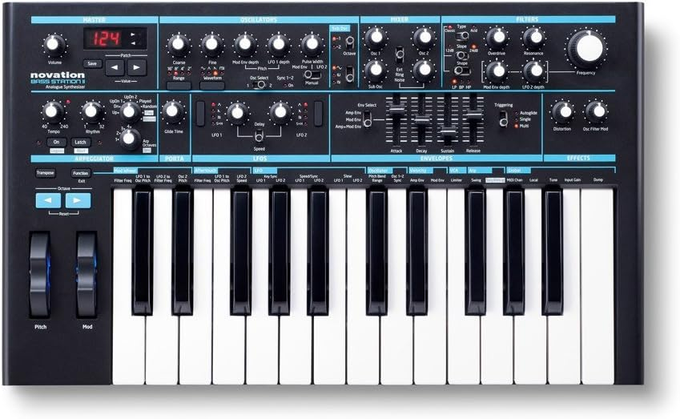
The original (1993) Should really be called the “sound station” due to its flexibility. Earth shattering synth bass, yes! But also lush soundscapes. I had one for many years, and it was a joy to play. The BassStation 2 has been around for a while, and the latest edition has USB and a few new features. Highly recommended.
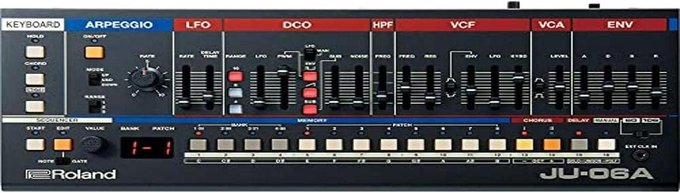
The Roland Juno-60 (1982) is a classic polyphonic synth. There was one at my college, and I spent as many lunchtimes as I could cranking it up and stressing the PA (and anyone in the surrounding area) with those immense filters. The reissue (JU-06A) is a compact, affordable, and modernized version that retains the original’s unique sound. WANT!
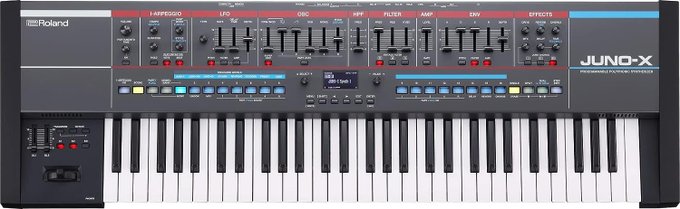
Not a straight “reissue” as such, but worthy of inclusion as the best bits of both these rare legends are combined in a monstrous reissued hybrid synth. The ROLAND Juno-X. Incredible.
This is a legendary synth (1978), and for good reason. Semi-modular and with a wicked filter. It’s been reissued twice – the Official Korg MS-20 Mini was overseen by the original team and is a faithful recreation – the only difference is it’s 86% of the size. I have one of these built in to my desk I love it so much!
Behringer have angered the synth Gods again with a much cheaper clone which is sick too. Heretics can pick up an extremely close version for about half the price.
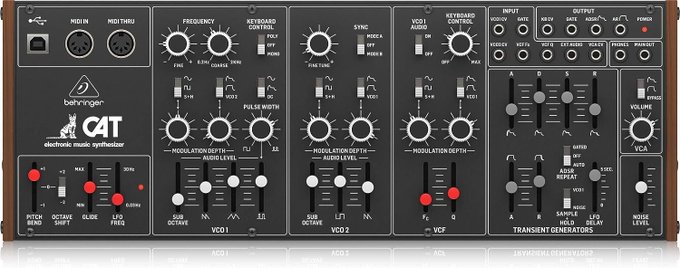
In the spirit of “generational reappropriation” shall we call it, the original Octave CAT was a copy of the ARP Odyssey – a truly groundbreaking synth from the 70’s. Now Behringer have copied the Octave CAT, with their own CAT.
Finishing off on a legend. The WASP. This innovative and quirky synth quickly became ingrained into synth lore. This reissue has a wealth of modern features but keeps to the spirit of the original.
Some of these synths don’t have the keyboard attached and need a separate controller keyboard to actually play it, without resorting to using the mouse only in your DAW (yawn!).
In case you don’t already have a controller keyboard, or are looking to upgrade to one with lots of assignable knobs and faders for hands-on control of your DAW and soft synths, here are some great options.
C1) Nektar Impact LX49+
This is the exact controller keyboard I use, so can personally attest to its quality. The drum pads, faders and dials all feel great. USB MIDI Keyboard Controller comes with with Nektar DAW Integration. Recommended.
This lovely 61-Key Semi-Weighted USB MIDI Keyboard Controller Including Assignable MPC Controls with 16 Pads, Q-Links, Buttons and Plug and Play Connectivity is a beast. AKAI are a quality brand, and this is a winner.
Here’s the AKAI in a mini version to carry with your laptop. A 25 Key USB MIDI Keyboard Controller with 8 Backlit Drum Pads, 8 Knobs and Music Production Software Included
Since these analogue synth reissues have tweakable knobs and faders built-in already, you don’t necessarily need knobs and faders on your controller keyboard (although they are still very handy for connecting to Soft Synths). This portable 32 Key USB MIDI Keyboard Controller with velocity sensitive keys is a good value option.
For a larger keyboard and quality feel, but without paying for assignable knobs and faders, this USB MIDI Controller Keyboard with Nektar DAW Integration is a great option.
You can get several of these reissues for around the same price as one of the original rare beasts. Sure, the reissues might not smell as musty, or have as many stains as an original, but the sound quality is great and all these have been meticulously engineered to be as close to the original as possible. Have fun tweaking your knobs!
Once you’ve made some fresh tunes with your synth, consider sending it to us for professional mixing / mastering https://fatasfunk.com
They say time flies when you’re having fun. Never truer than when spending the last 17 years working on amazing music.
I don’t really talk about myself much at all (ever really), but 17 years is quite a while to be doing a job, so this post is a little bit about my journey so far.
Firstly, It’s been an absolute pleasure and privilege to work on all your amazing tunes over the years. I appreciate every one of you, from those just starting out in the game, through to some of the biggest independent labels, artists, sync agents, music libraries and pressing plants in the industry. I’m very glad to have made some real friends along the way too.
Far too many to name in this post without excluding others, but you can check out my (probably very incomplete) client list.
The Journey So Far
Fat As Funk was one of the very first mastering companies to offer a free taster back in 2006. This approach combined with trips to numerous music conferences and networking parties got me a lot of clients quite fast, and off we went. 17 years later and I’m not quite sure where the time has gone!
It’s really satisfying to help a new producer get their first release sounding as good as their inspirations, and hearing just how thrilled they are – wonderful! Take that enthusiasm forward and blow up your scene! Likewise when a band like Bilk drops their debut e.p. and it exceeds all expectations it’s great to have been a small part of it.
Also very satisfying seeing some tracks I’ve worked on getting major radio and DJ support all over the world, including several times the number 1 slot on Spotify for their genre, or a couple of times Radio 1’s “Hottest Record In The World Right Now” (Tommy Farrow “Let’s Just” and Prospa’s “Prayer”). Recently I noticed my regular client Lau.Ra did her first BBC Radio 1 Essential Mix. As a huge fan of the series growing up, this made me smile.
Occasionally walking into a shop and hearing something on the radio, like the ubiquitous “Another Lifetime” by Luxxury & Scavenger Hunt and”Keep It Together” by Kraak & Smaak which I keep on hearing in unexpected places a couple of years after their release.
Hearing my work in an A-List Hollywood trailer or movie is a buzz (especially when I’ve also helped land the sync placement, but more on that later).
A few times, artists have sent me a reference track to emulate for their mastering, and I come back to them saying “I mastered that one” and we have an instant “Ayyyyyyy!” Bro moment 🙂
I lost track of exactly how many tracks I’ve worked on a while back, but it must be well over 14,000 now. I’ve worked on music from literally every continent, and feel lucky to hear what’s cooking in the underground in some of the most far-flung corners of the world.
“The Underwater Hunter” by the Industrial Battle Orchestra. Mixed and Mastered by Fat As Funk.
Music S.O.S.
I get a special warm fuzzy feeling from rescuing old treasured recordings, sometimes for the families of people who have died, or an old-timer wanting to get their legacy in order and sounding great for their grandkids. They are so overjoyed to hear these wonderful memories restored, it makes me emotional every time. These jobs don’t happen very often, but they are always special when they do. I am currently cleaning up and augmenting some folk songs by a guy in the US which were recorded “on a $25 tape machine many years ago” including a song he recorded for his wife who died. There wouldn’t be a dry eye in the house if you heard it.
Likewise when the itch to scratch some vinyl comes around, but artists only have their masters pushed hard for digital use, and without access to the unmastered files we step in to solve the problem. Although people do sometimes risk pressing super-pushed masters on to vinyl, it is not recommended as they will often not translate brilliantly, and can even run the risk of making the needle jump if there are low frequencies out of phase. I have done a tonne of pre-vinyl rescue work over the years including for superstar Sophie Ellis Bextor and recently the controversial but critically acclaimed UK rapper Potter Payper.
We can optimise any tracks for the best vinyl results. Vinyl is so expensive to get pressed, there’s no point taking a risk at the last stage.
It’s a pleasure to make people so happy with their music. You can read some testimonials to see some nice things people have said.
Moving In Sync
I have also been working in the sync world for a while, visiting Los Angeles 6 times to hustle up direct connections in Hollywood and setting up a 3rd party licensing agency Rinse The Sync. This went pretty well, getting my artists music placed on many shows and films like Royal Pains (NBCUni), The Driver (BBC), A Hundred Streets, Spotless, The Five, Underworld:Blood Wars (trailer and movie) – all Fat As Funk mastering clients.
I have since moved away from 3rd party representation, and instead have set up a sync-focused music library Alternative Reality Music which has been picking up speed. It’s still fairly new, but I have a great sub-publisher based in LA, and we are starting to get placements on Netflix and other platforms. More of a slow burn, but also more sustainable.
I am looking to sign material in all genres for the library, and have signed up lots of tracks from Fat As Funk’s roster already for the catalogue. There is more chance of your music being noticed and pitched from a smaller library like ours than one of the huge ones with 6 million tracks. I am also gathering tracks for a different flavour library with a grittier, harder electronic edge. If you are interested, send me an email for more details (but use a different email address to the mastering one please:publishing (at) rinsethesync (dot) com )
I’m lucky to have had some of my own music placed too. Most notably landed some music and sound design in the international trailers for Alien:Covenant, Antlers, a Sprite advert, The Driver, had some of my sound design in the Logan trailer and music in The Book Of Boba Fett promo with a track I composed 50/50 with a buddy.
Some TV and Podcast Work
I came to the rescue for two series of wellness programmes on Sky TV “Feel Good Factor” on recommendation. The producers were having a nightmare as the sound recordist had ended the relationship on bad terms and left them with a load of extremely messy audio. Some of which was horrifically recorded, and they could not re-record the interviews due to Covid. I came in around part way though the first season and made the audio broadcast quality.
I have done various other TV mixing and post production, including remixing Ludacris’s tracks for the cool Netflix kids show Karma’s World for seasons 1 and 2. The same agency commissioned me to edit the music for a pilot cartoon show with Ronaldo and Messi called GOAT, which I don’t think ever came of anything, but was a fun job anyway.
I’ve recently been working on some spoken word audio including the excellent “Pitch Masters” podcast which is nominated for the MR2023 Podcast award. As a complete contrast, late last year I edited some rather fruity “adult” voiceover for the female-centered erotic story company Emjoy. Never done that before, but it was great fun! Never a dull day in the studio.
Final Thoughts
What I am most thankful for is the vast majority of my clients are regulars who come back time & time again, and most new clients come from their recommendations.
This means I have not needed to advertise at all for many years, and it also buffers against my rubbish social media presence haha (phew!). As I say every year… I must do better on the socials haha. Maybe this year will be the one…. Now that I mention it, If you would follow/like/share and all that stuff it would be appreciated. I often send out exclusive discounts on services to my email subscribers too.
As a lover of the countryside, I haven’t been tempted to move to London (although I do love visiting it), so have been able to keep my overheads low, and my prices extremely competitive. I truly feel Fat As Funk offers the best value:quality ratio in the business, and I’m very proud of that.
If I can help with mix evaluations, mixing, mastering, sync advice, vinyl optimisation, podcasts or anything along those lines, feel free to get in touch.
Likewise, if you have some excellent back-catalogue sitting around gathering dust consider sending it over for consideration into the library. Or you could write us something fresh!
So once again, thank you for being such awesome people. Keep the music coming! We’ll make it Fat As Funk together.
One of the most powerful and versatile tools in your mixing arsenal is mid-side processing. Mid-side processing allows you to separate the stereo signal of your mix into two components: the mid and the side. The mid component contains the audio that is common to both the left and right channels (Centre Mono), while the side component contains the audio that is different between the left and right channels (the Left and Right).
By processing the mid and side components independently, you can shape the stereo image of your mix in radically different ways, creating more depth, width, and clarity. You can also fix frequency imbalances, remove unwanted resonances, and create more contrast and separation between the elements in your mix. Alternatively you can use it in more subtle ways for mastering to enhance or fix a mix.
In this blog post, we’ll show you what mid-side EQ processing is, how it works, when to use mid side processing, and how you can use it to improve your mixes. We’ll also show you how to use hardware outboard gear to achieve it.
What is Mid-Side Processing?
Mid-side processing is a technique that allows you to separate a stereo signal into two components: mid and side. The mid contains audio common to both channels (mono), while the side contains the differences between the left and right channels.
By splitting the stereo signal into mid and side components, you can apply different EQ, compression or effects settings to each component, and then blend them back together to create a new stereo signal.
Mid-side EQ processing gives you more control over the stereo image of your mix, as you can adjust the frequency balance of the center and the sides of your mix separately. You can shape the stereo image, creating more depth, width, and clarity in a mix. You can fix frequency imbalances, remove resonances, and make elements stand out in the stereo field. Used subtly, mid-side EQ can also enhance a mix for mastering.
How to Use Mid-Side Processing with Software Plug-ins
Using mid-side processing with software plug-ins is very easy and convenient. Many software EQ and compressor plug-ins have built-in mid-side functionality, which allows you to switch between stereo mode, mid mode, and side mode for each EQ band, or compress the different elements separately.
We will use an EQ plugin in this example. Follow these steps:
1. Load a mid side compatible EQ plug-in (like The PSP Neon, Fabfilter or Pro-Q) on your stereo track or bus that you want to process.
2. Activate an EQ band that you want to use for mid-side processing.
3. Switch the mode of the band from stereo to mid or side, depending on which component you want to process.
4. Adjust the frequency, gain, and Q of the band as desired.
5. Repeat steps 2-4 for other bands if needed.
6. Adjust the output gain and bypass switch as needed.
Using software plug-ins for mid-side EQ processing gives you a lot of flexibility and precision. You can easily switch between modes, adjust parameters, and compare results. You can also use different filter shapes and modes for each band, such as low-cut, high-cut, bell, shelf, notch, etc.
How to Use Mid-Side EQ Processing with Hardware Outboard Gear
Using mid-side EQ processing with hardware outboard gear is a bit more complicated but also more rewarding. Hardware outboard gear can give you a unique sound quality and character that software plug-ins cannot replicate. However, most hardware outboard gear does not have built-in mid-side functionality, so you need to use some additional equipment and routing to achieve it.
Here are the steps you need to follow:
You need a plugin that can encode and decode mid-side signals, such as the Voxengo MSED
You need two channels of hardware EQ that you want to use for mid-side processing.
You need an audio interface, mixer or a patchbay that can route the signals from your DAW to your hardware devices and back.
Connect your mid-side encoder plugin to the stereo output of your DAW, to encode the output to M/S mode.
Usually the mid is on the Left output, and the Side is on the Right channel.
Connect the mid (Left) output of your encoder device to the input of one channel of your hardware EQ.
Connect the side (Right) output of your encoder device to the input of another channel of your hardware EQ.
Connect the output of each channel of your hardware EQ back in to to a separate input on your audio interface.
Add another instance of your MS plugin on the stereo input channel of your DAW. Set this one to Decode.
Activate input monitoring on this channel in your DAW, to listen to the audio coming in from the EQ in realtime. This should now be in M/S mode, and you have the ability to EQ the mid and side separately!
Record the MS EQ’d signal in to your DAW. You will usually notice it appears to be overbalanced to the left, however this is actually the mid, not left, and the mid is usually louder than the side! On playback, make sure you have an MS plugin set to Decode, to hear it naturally.
Now you can use your hardware EQs to process the mid and side components of your stereo signal separately, and then blend them back together with your decoder device.
Some examples of how you can use mid-side EQ processing with hardware outboard gear are:
You can boost the high frequencies on the side component to create more air and sparkle on your stereo image, while leaving the mid component untouched or slightly attenuated to avoid harshness or sibilance.
You can cut the low frequencies on the side component to reduce muddiness and increase mono compatibility, while leaving the low frequencies alone, or boosting them on the mid component to add more punch and weight to your mix.
You can notch out unwanted resonances or frequencies on either the mid or the side component, depending on where they are located in your mix, without affecting the other component.
You can create more contrast and separation between elements in your mix by boosting or cutting different frequency ranges on the mid and side components, such as making vocals more prominent in the center or making guitars wider on the sides.
Benefits and Drawbacks of Mid-Side EQ Processing
Mid-side EQ processing is a powerful and versatile technique that can help you shape and enhance your stereo image in many ways. However, it also has some potential drawbacks and pitfalls that you should be aware of before using it. Some benefits of mid-side EQ processing are:
It gives you more control over the frequency balance and tonal character of your mix, as you can adjust each component independently.
It allows you to fix frequency imbalances, remove unwanted resonances, and create more contrast and separation between elements in your mix.
It can help you create more depth, width, and clarity in your stereo image, as well as more interest and excitement for the listener.
Some drawbacks of mid-side EQ processing are:
It can introduce phase issues and artefacts if not done properly or excessively, especially when using linear-phase EQs or steep filters.
It can compromise mono compatibility if you make drastic changes to either component, especially on low frequencies or across a wide frequency range.
It can make your mix sound unnatural or exaggerated if you overdo it or use it for everything, instead of using it selectively and subtly.
Conclusion
Mid-side EQ processing is a technique that splits a stereo signal into two components: mid and side. By processing each component separately, you can shape the stereo image of your mix in radically different ways, creating more depth, width, and clarity. You can use mid-side EQ processing with software plug-ins or hardware outboard gear, depending on your preference and budget. However, you should always use it with caution and moderation, as it can also introduce problems and artefacts if not done properly. Mid-side EQ processing is not a magic bullet that will fix all your mixing issues, but rather a tool that can help you enhance what is already good in your mix. Use it wisely and sparingly, and you will be rewarded with better sounding mixes.
We hope this blog post has helped you understand what mid-side EQ processing is, how it works, and how you can use it to improve your mixes.
Here at Fat As Funk, we are extremely experienced in using various M/S techniques in both mixing and mastering, and we use the technique regularly.
When artists ask “How loud should my master be”, what they probably mean (technically speaking) is “What LUFS should my master be?”. But understanding the concept behind integrated LUFS vs dB (decibels) is essential, and can be confusing.
What are LUFS in audio? = LUFS stands for Loudness Units relative to Full Scale (or just “Loudness Units/LU”). They are a way of measuring the intrinsic volume of a piece of audio, relative to 0dB which is the absolute loudest signal possible in digital audio – in the same way that a cup can only ever be filled up to 100% full, and no more. You cannot push digital audio beyond 0dB without clipping (like overflowing in our cup example).
A cup with 100ml capacity can only ever hold a maximum of 100ml. The same theory holds in digital audio, where 0dB is the audio measurement equivalent of the maximum capacity of the cup to hold water.
Practically speaking, a LUFS measurement tells you the perceived loudness of a piece of music across a sustained measure of time, and this LUFS measurement is the most accurate reflection of how “fat”, “full” or “hefty” the track will sound compared to similar tracks, when played through the same Soundsystem, at the same volume (without any automatic volume levelling system).
LUFS are very similar to the more famous dB/decibel. Actually, in practical terms 1dB is the same amount as 1LU. So if you lower the volume of something by -3LUFS, you could also say you reduced it by -3dB.
So what’s the difference between dB and LUFS? Both LUFS and dB can be used to express a measurement of difference between 2 things e.g. “take the vocals down -2dB” (from where they are now), or a fixed volume reference (e.g. “the neighbours registered a noise complaint of 80dB” (compared to the base reading 0dB of the meter at measurement location).
The most important dB vs LUFS difference from a professional audio work perspective is that the dB scale represents how much air pressure a sound will produce over a very short time, and needs to be referenced to another point (which is standard air pressure) to get a measurement.
In contrast, LUFS is a unit of measurement measured from within the audio, relative to the loudest it could possibly be, and measured over a longer time.
So the LUFS measurement is more similar to measuring how much water we have in our cup with 100ml capacity. LUFS is measured backwards from full-scale (full capacity), so using our 100ml cup analogy again, if we had 90ml of water in the cup, you could also say you had the capacity of 10ml left, or -10ml to full capacity. If you only measured from an empty cup (with 100ml capacity available), through to to 0ml capacity left (a full cup), then if you had 50ml water in the cup, there would be -50ml capacity available… If you had 60ml water in there, the spare capacity measurement would be -40ml… If you had 20ml of water in there, the spare capacity would be -80ml etc.
Same idea for digital audio measurement: digital audio can only ever go to a maximum point before clipping (the cup overflowing), which is always referenced at 0dB (our full capacity). Both dB and LUFS are measured like this. So a measurement of -5dB means you can raise the volume up another 5dB before the audio clips (the cup runneth over). A measurement of -10LUFS means there’s a limit of another 10LUFS before the audio is the loudest it could ever possibly be (the full cup again). So if dB and LUFS are so similar, where does the difference lie?
Measuring audio using LUFS gives a more accurate picture of the track volume over a longer time (often the entire track is measured and represented). So a whole tracks LUFS measurement takes into account all the quiet sections and loud sections too, rather than just being measured at one specific point like with dB.
LUFS are the best unit we have to measure audio loudness at the moment, but when finishing a master you still need to use your ears rather than trust the numbers blindly, as so many other factors come in to play in perception of the listener, like genre, tempo, instrumentation and vocal styles. Especially if considering tracks across an album.
For some heavy music styles, the published target LUFS for Spotify may not actually reflect your musical intention perfectly either, and you will probably find your music lacks a certain “oomph” if you stick rigidly to the published targets!
If you want to read more about why LUFS standard for streaming may not give the results you want in all situations, and more info about LUFS when mastering check out this deeper dive article: How Loud Should My Master Be In 2022? Which covers questions like how many lufs should my master be, Spotify lufs, lufs for Soundcloud, lufs and true peak for Spotify and more.
What can I do if I don’t have instrumental mixes of my songs?
Special discount until the end of August 2022!
What is Sync Licensing?
How do artists make money from their music in 2022? Getting your music on TV or in movies, games or advertising is one of the most lucrative ways for musicians to earn serious money. This process is called “Sync Licensing”.
“Sync” is short for synchronisation. In music industry terms this simply means using music synched up to visuals in a project – almost every advert, TV show, movie or video game uses music synched up alongside the visuals. The process of a company licensing a track from an artist or agency to use in this way is known as Sync Licensing.
It is still common to land deals worth several thousand pounds, even for emerging artists (Fat As Funk works closely with various sync agencies in the UK and USA and has helped land artists many sync deals).
Loz from Fat As Funk at Capitol Records in Los Angeles, as part of a Sync Industry conference.
What are Instrumentals?
An instrumental is simply a version of your song with the lyrics or vocal tones silenced. Even slight vocal effects or “oohs / aahs” need to be muted for an instrumental version, but the underlying track tone and arrangement is identical to the main version. It is standard professional practice to get instrumental masters done at the same time as getting your main mixes mastered.
Why are instrumental versions so essential for sync licensing?
Often a music supervisor (the person responsible for choosing the music for a visual project) loves a track, but the project requires music with no vocals.
This could be for many reasons, including having a spoken voiceover which song lyrics would mask – and for the client, their message is the most important thing, and ultimately what they are paying to convey.
Some videos just work better with instrumental music! Lyrics could distract from the visuals, or dilute the message.
Often a TV show or movie will use both the vocal version and instrumental mix! Editors can use a vocal song where the lyrics help the scene, then cut seamlessly into the instrumental when the characters are speaking, so their dialogue comes through clearly. This flexibility is golden to editors, and music supervisors expect this flexibility.
Is it possible to get instrumental versions from vocal mixes, if I don’t have the project any more?
YES! We can remove the vocals from your mix as if by magic! Results are usually super-clean and often sound identical in quality as if you made an instrumental mix from the original project file.
Occasionally the process can leave slight vocal artefacts behind with some tracks, but it will be good enough to supply to a music supervisor with your main mix, and even worse-case will certainly be good enough to use behind dialogue.
Having an instrumental version is the difference between a music supervisor choosing your track over someone else’s. It is an essential part of the modern music industry, and even if you are not yet in the position to have music supervisors listening to your tracks, it is a no-brainer to get instrumental masters done at the same time as your regular mastering job.
We can also magically separate your track into its component parts (“Stems“) which can be even more useful for music supervisors. Check out our Magic Stem Creation Service too!
To get a hugely discounted rate on instrumental mastering, you should order the alternative instrumental versions at the same time as getting your regular masters done.
Just upload your main mixes and instrumentals to us (or order our magic instrumental creation service if you don’t have them already), then order Stereo Mastering (for the main masters) AND Alternative Version (for the discounted instrumental mastering).
We are offering a HALF PRICE deal on Instrumental Mastering until the end of August 2022. Just order as usual and enter the code: SUMMER22ALT at checkout!
To be extra-clear, if your track is only an instrumental anyway, you only need to book the main Stereo Mastering. If you are using our magic instrumental mix creation service, you still need to purchase the Alternative Version too, as these are separate services.
Make your musical ambition a reality, and start by getting your audio quality slick and professional. In this email I give some tips on stem mastering, and when it’s most needed.
Add 2 x FREE stems per track (£14 value) with code: 2022FreeStemsOffer Order “Stereo Mastering” then select “Add Stems” and use the code at checkout to get 2 x free stems!
(You can use the code up to 5 times! Get 5 x stem mastered tracks done & save £70! Code doesn’t expire until the end of June 2022. Scroll down for more details)
Topics covered: What is Stem Mastering? How can it help improve your music productions? How is it different to “regular” stereo mastering?
The difference between a good master & a fantastic master is subtle but important…. A great one just has “something special” about it, which noticeably adds to the overall impact of the track, but isn’t always easy to pin down why. It just sounds “quality”! Labels, sync agents, music supervisors and playlist curators notice the difference.Mastering is like most things in life – the better the input, the better the output. So today we are going to talk about Stem Mastering, which can help optimize a few of the most demanding parts of a mix as an integral part of the mastering job.
What is Stem Mastering? Stem mastering is like a mini-mix combined with mastering. It can optimize a mix that’s already great, or correct a few difficult elements and rescue a mix that would otherwise have major issues.A mediocre mix will be massively improved by an experienced mastering engineer anyway, but think how much slicker the end result would be if the tricky mix elements were perfected.Stem mastering is the process of sending certain parts of your mix separately, so the mastering engineer can adjust key elements individually during the mastering process.Often during mastering certain elements get highlighted and mix flaws revealed. It’s really useful for the engineer to be able to adjust these aspects on the fly to get the best end result.For example, there may be an instrument that overlaps the frequency band of a vocal performance, and during the mastering process the vocal needs a little EQ tweak… but this makes the other instrument sound harsh. Or vice-versa and adjusting a harshness in the other instrument then dulls the vocal. It would be helpful to be able to adjust these elements with a little more separation (there are A.I. tools that can be useful, but they are hit-and-miss sometimes).
When do you need stem mastering? Low-end problems (kick, bass, sub):Many technically excellent, talented producers don’t have the luxury of a fully accurate listening environment which can cause problems balancing their low-end. Matching the kick & sub levels between each other is a very common problem which relies on both accurate monitoring AND environment.There are a few A.I. driven tools on the market which are helpful, but in my experience they don’t quite get it right most of the time. I often use one in my chain, but the majority of the time (90%+) I don’t actually follow its suggestions completely, and use it more as a quick way to check another approach, like a second pair of ears to ask an opinion of. The neutral room + human ears still give the best results tailored to your track.Vocal balancing:A vocal is one of the most tricky parts to make sit naturally inside a mix, and because we all know the sound of a human voice intimately, a vocal that’s not quite blended perfectly is the easiest way to make an otherwise amazing mix go downhill. So many talented producers find getting the vocal to sit right the most challenging part of a mix. If this is you, you are not alone!The highest level mix optimisation:Even if your mix is pretty damn great already, and you just want to get the most optimized mastering possible, then stem mastering can make that happen. It gives the engineer full flexibility to tweak micro aspects of the master and get really precise for ultimate results.Weak sounding drums:A classic problem, especially when using live drums. The track is banging, guitars sound huge, vocal is great, bass is thumping, but the drums sound weak and let the whole track down. By sending the drums as a separate stem we can give the extra push needed to fatten them up in the mix.Any instrument that isn’t “sitting right”:Don’t let it annoy you. Send it separately as a stem and let the engineer fix this in the mastering.
How To Set Up A Stem Master: It is good general practice when mixing a song to group various elements to different subs/buses before the master output fader. This is helpful for many reasons: You can pull down just 1 fader to adjust all the drum channels for example, or effect all vocal channels with 1 effect. Or send different parts of your track to 1 reverb… Or many other cool things beyond the scope of this article! Sending grouped parts to buses is also useful in optimizing your gain structure to avoid clipping. It’s generally a good habit to have when mixing.When you export your mix, you will choose the option that exports all these different buses separately – these individually grouped wav files will be your stems.
There’s no specific rules for what parts to use as stems – it will vary depending on how many instruments are causing issues, or how complex your track is.Often you will only need 1 or 2 stems to get an optimized result. Vocals and Drums are common choices in this scenario.
For a rock stem mastering job, you might have the following stems: vocals drums bass rhythm guitars lead guitar synth
Or for an electronic track:
kick drum other drums bass sounds soft sounds hard sounds
This is a common stem setup for a dance track: kick drum Bass sounds everything else
Tricky vocal?: lead vocal backing vocals everything else (also makes it a breeze to bounce an instrumental master version at the same time)
Lots of options! Note how sometimes I’ve grouped them as “hard” & “soft” sounds – really it depends on the track and what elements work most naturally together.
Once you have chosen the best stem configuration for your mix, export them (“Export – Buses” or similar), then load them up in a new project and check to make sure they play back exactly the same as your normal stereo mix.
Feel free to reach out to us for advice if you have any problems making stems.
Send them all separately in a zip file to us HERE, along with a regular stereo copy of your full mix as a reference so the engineer can check all is correct.
Final thoughts: Stem mastering is not essential for every track. But on a tricky or complex mix it can make the difference between a good final result and a fantastic final result.
It doesn’t have to be expensive either. For example, at Fat As Funk Mastering, you can add a stem for just £7 on top of the mastering cost (or free with this offer!).Try stem mastering on your new track and see how much difference it can make.
Try our stem mastering for free: Add 2 x free stems per track with code: 2022FreeStemsOffer (Order Stereo Mastering + Add Stems, & add the code at checkout for the 2 x free stems discount per track. You can use it up to 5 separate times to get 5 x tracks stem mastered & save up to £70! Code doesn’t expire until the end of June 2022)